
Whoever governs, three in four opposition questions go without a full answer: ten years of PMQs
Anthony Lawton, Fit to Care
Parliament is back this week, and Prime Minister's Questions with it. Ten years of the record show what the weekly half hour actually produces.
We looked at 9,480 answers the Prime Minister gave in person, from January 2016 to September 2026. Only 36% gave a full answer to the question asked. Most of the rest gave a partial answer or none; about 7% could not be judged or were set aside. Of the answers that could be judged, six in ten fell short.
Whoever governs, the opposition goes without a full answer
The clearest pattern is not about any one party. It is about which side of the House you sit on.
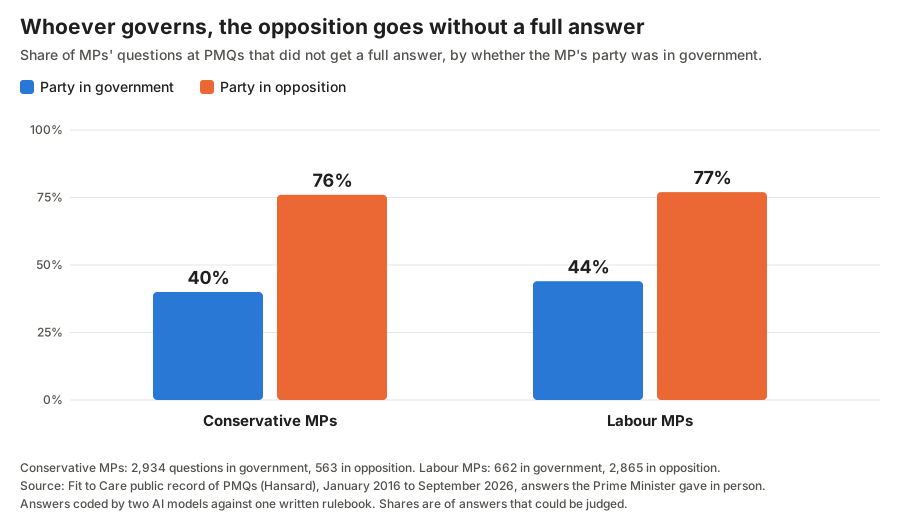
When the Conservatives governed, Conservative MPs' questions went without a full answer 40% of the time. When Labour governed, Labour MPs' questions went without a full answer 44% of the time. In opposition, both parties' MPs went without a full answer about three times in four: 76% for Conservatives, 77% for Labour.
Same chamber, same pattern, whichever party holds the despatch box.
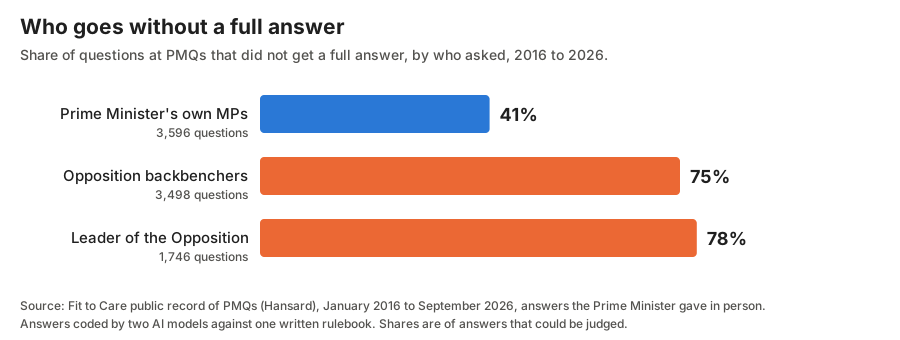
The Leader of the Opposition, who leads the opposition's questions each week, went without a full answer 78% of the time. MPs from the SNP, the Liberal Democrats and the Green Party, none of which held government in this period, went without a full answer between 75% and 79% of the time. Reform UK MPs asked too few questions in this period, 24, for a reliable figure.
Some of the gap is fair. A question from the Prime Minister's own side is often an invitation to talk about something the government is proud of, and that is easy to answer in full. An opposition question is often built to be hard to answer. But a gap this size, under almost every Prime Minister (the short Truss period is too small to judge), suggests the format rewards scoring the point over answering it.
Getting personal does not get answers
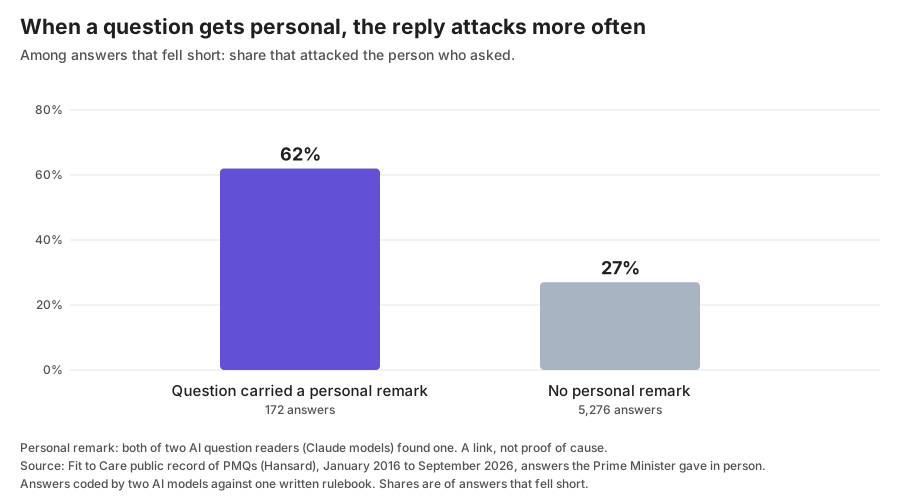
Personal remarks, a dig at the person rather than the policy, were rare: 228 of the 8,840 questions whose answers could be judged. Once we allowed for who was asking and when, they made little clear difference to whether a question got a full answer.
What they did go with was a different kind of non-answer. Where an answer fell short and the question carried a personal remark, 62% of those answers attacked the questioner (107 of 172; not adjusted for who asked). Without a personal remark, 27% did. The dig did not buy more answers. It tended to come with a counter-attack.
What a non-answer looks like
Of the 5,448 answers that fell short, the most common move was to change the subject, in 45% of them. Attacking the questioner came next, in 28%. Then came a narrow reassurance that did not meet the point (16%), and a reason for not answering that the questioner never accepted (12%).
One more pattern is worth any MP's attention. Questions that asked three or more things at once went without a full answer 93% of the time, against 61% for other questions. There were only 71 of them, and a question with three asks is harder to answer in full, but the record suggests one clear question has a better chance than three.
What this could mean
None of this tells us any individual is acting in bad faith. It describes a format in which both sides have learned the moves. The opposition often asks to land a blow, the Prime Minister often answers to win the exchange, and the public is left without the answer.
If a party wants more answers and less point scoring, the record suggests where to start: one question at a time, no personal remark, and answers that meet the question, whichever side asks it.
Can AI judge this more consistently than people?
Deciding whether an answer is full is hard, and people find it hard to agree. Three people are marking the same 50 answers, each choosing before seeing the AI's verdict. On the 27 answers all three have marked, all three agree on only 6, and two of the three pairs agree no better than chance.
The two AI readers, both Google Gemini models working separately to one written rulebook, agreed with each other on 82% of all 9,480 answers, well beyond chance (Cohen's kappa 0.74). These are not the same answers the people marked, and two readers from one model family may share the same blind spots, so their agreement shows consistency, not proof that they are right.
In one small test, on 30 answers, Anthony Lawton, who built the record, marked each one first and was then shown the AI's reasons. The other two markers were also shown the reasons after making their choice. He is not independent of the work. His first choice matched the AI on 16 of 29 judged answers. After reading the reasons, he agreed on 23 (79%), seven more than before. That shows the reasons can persuade the person who built the record. It does not show the AI is right.
That is why, for now, the published figures come from the AI readers under fixed rules, with a small human check so far, and not from anyone's individual marking.
What we will test next
This is a first look, and we are designing more work to test it:
- a larger human check, in which people mark answers without seeing what the AI decided;
- a study we hope to run with a university research team, on whether showing the working behind each verdict changes how people ask and answer;
- a second reading of the record by an AI model from a different company, so the readers check each other more independently.
Where this work goes ahead, we will publish what it finds here, including anything that weakens these results.
Who has this
On the day this piece went up, we sent the same findings and links to the offices of the leaders of Labour, the Conservatives, the Liberal Democrats, the SNP, the Green Party and Reform UK, and to a small number of journalists and researchers who study or report on political questioning. None of them got them before the others. Any party or person may reply, and every correction we make goes in the public corrections log.
Three questions to weigh
If both main parties go without a full answer three times in four in opposition, is the problem the people or the format? The pattern was almost the same for Conservative and Labour MPs: 76% and 77% in opposition, 40% and 44% in government.
Who gains from the personal remark? It went with little clear change in whether a question was answered, and with more than twice the rate of replies that attacked the questioner (62% against 27%).
What would it take for one side to go first? Personal remarks were in 228 of 8,840 judged questions, and questions with three or more asks were 71. Changing them would not mean changing most of PMQs.
How we did this, and its limits
- The record covers every Prime Minister's Questions in Hansard from January 2016 to September 2026, 329 sessions where the Prime Minister answered in person; 30 sessions answered by a deputy are left out. These are the same figures as our public record page. Two AI models from Google's Gemini family each coded every answer as a full answer or not, against one written rulebook, with fixed rules for when they disagreed. Answers that could not be judged, were cut off, were challenged on a point of order, or were declined for a recognised reason are left out.
- Personal remarks and the number of things asked were read by two other AI models, from Anthropic's Claude family. A question counts as carrying a personal remark only where both found one.
- The human check so far: Anthony Lawton's first choices matched the AI on 29 of 49 judged answers; a second marker on 26 of 50; a third on 13 of 27. The two AI readers agree with each other beyond chance at a level the usual scale calls substantial (Cohen's kappa 0.74). The sample is small and no large blind human check has yet been done, so treat these results as provisional.
- These are links, not proof of cause. The AI that coded each answer could also see the question.
- "In government" and "in opposition" follow which party held office on the day. Labour has governed only since July 2024, so there are fewer questions from Labour MPs in government (662) than in opposition (2,865). Each MP's party comes from official Parliament records.
- Unless stated, the shares are of answers that could be judged. The figure for personal remarks and answering is adjusted for who asked and when; the other figures are simple shares.
Changes to this piece
An earlier, shorter version of this piece was online for about two hours on 14 October 2026, before any of the emails above were sent. This version replaces it with fuller figures and corrects one detail: the earlier version said the AI that spotted personal remarks was from Google; it was from Anthropic.
Sources
- Hansard, House of Commons Official Report, Prime Minister's Questions, January 2016 to September 2026, read through the Fit to Care public record of Prime Minister's Questions (method, rulebook and corrections log at /resources/pmqs-record).
- Fit to Care analysis of the record, 14 October 2026. Every figure in this piece comes from code output.
The data behind this piece: Did they answer? A public record of Prime Minister's Questions
No record is perfect. If you find an error, write to anthony.lawton@ffmi.co.uk with the subject "The Record correction" and it is corrected within 48 hours, in public, on the piece itself.